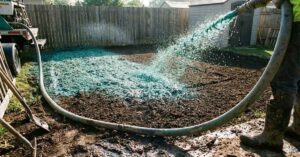
Look, I get it. You see a single day of 50-degree weather in February and suddenly you’re at the big-box store loading up the trunk with enough nitrogen to green up a desert. You want to be the first house on the block with a neon-green lawn. But here is the cold, hard truth: you are probably just throwing money into the storm drain.
Every year, I watch homeowners treat their lawns like a competitive eating contest. You think more is better. You think earlier is better. You’re wrong on both counts. A recent 2025 global study, including researchers from Binghamton University, has flipped the script on how we look at nutrient uptake. While the study found that the right fertilizer can actually help grass survive extreme drought, the key word there is right.
If you put that bag down while the ground is still waking up, the grass can’t eat it. It’s like trying to feed a steak to someone who is still fast asleep. It just sits there, stinks, and eventually washes away when the next spring rain hits. Stop guessing. Your calendar is lying to you, and your neighbor who fertilizes in March is just a victim of good marketing.
When is the best time to fertilize your lawn in 2026?
According to the latest university research, the exact time to fertilize your lawn is when soil temperatures consistently hit 55°F and you have mowed the grass at least twice. For most of the US, this window falls between late April and Memorial Day. Feeding earlier wastes nitrogen through runoff and weakens root systems.
The “Early Bird” Myth That Is Killing Your Roots
We have been conditioned by glossy circulars to think that “Early Spring” means as soon as the snow melts. That is a load of mulch. If you feed the lawn too early, you force the grass to dump all its energy into top growth. Sure, it looks green for a week. But underground, the roots are starving.
When the summer heat hits in July, that “early-fed” grass is the first to turn brown because it doesn’t have the root depth to find water. I’ve seen it a thousand times. You want a lawn that survives, not just one that looks pretty for a photo in May.
The 2025 study showed that nutrients like nitrogen and phosphorus are vital for surviving climate extremes, but the plant has to be in an active growth phase to actually use them. If the soil is cold, the microbes that help the grass digest that fertilizer are still hibernating. You aren’t feeding the lawn; you’re just salting the earth.
The Soil Temperature Rule
Forget the date. I don’t care if it’s St. Patrick’s Day or Tax Day. You need a soil thermometer, or at least a local weather app that tracks soil temps.
Grass won’t efficiently take up nutrients until the soil is 55°F at a three-inch depth. Before that, you’re just polluting the local creek. If you want to get a head start, check out this guide on garden soil testing spring preparation to see what your dirt actually needs before you go buying bags of “miracle” junk.
Regional Fertilization Timing Guide (Spring 2026)
| Region | Grass Type | Soil Temp Target | Expected Window |
| Northern / Midwest | Cool-Season (Fescue, Bluegrass) | 55°F – 60°F | Late April to Mid-May |
| Transition Zone | Mixed / Tall Fescue | 60°F | Early April to May |
| Southern / Gulf | Warm-Season (Bermuda, St. Augustine) | 65°F+ | Late March to April |
| Pacific Northwest | Fine Fescue / Ryegrass | 50°F – 55°F | Mid-April |
Stop Buying “Weed and Feed”
If there’s one thing that gets my blood pressure up, it’s those “all-in-one” bags. They are the “spork” of the garden world—they do two things poorly instead of one thing well.
Weed control needs to happen when the weeds are actually growing and the leaves are wet so the powder sticks. Fertilizer needs to be watered in to reach the roots. You see the problem? You’re either not killing the weeds or you’re burning the grass. Do yourself a favor: buy a dedicated fertilizer and spot-treat your weeds separately. If you’re dealing with a mess of moss from a wet winter, use a natural moss soap treatment instead of dumping heavy chemicals everywhere.
The 2025 Study: A New Perspective on Drought
The study published in mid-2025 highlighted something we’ve suspected for a while: nitrogen isn’t just for “green.” When applied correctly, it builds a chemical resilience in the grass blades that helps them hold onto water during heatwaves.
However, the researchers noted that over-application had the opposite effect, making the grass “lazy.” If the grass has too much easy-access nitrogen, it stops trying to grow deep roots. You want your grass to work for its living.
Why You Should Wait for the Second Mow
I tell my readers this every year, and half of you still ignore me: Don’t fertilize until you’ve mowed the grass twice. Why? Because the first mow of the year is usually just knocking off the “winter tan.” By the second mow, the grass is actively pushing new growth. This is the signal that the root system is awake and the “engine” is running. If you put best fertilizer for grass down then, the plant will suck it up like a kid with a milkshake.
Understanding the Numbers (NPK for Humans)
That bag has three numbers on it (like 10-10-10 or 29-3-4). If you don’t know what they mean, put the bag back.
- Nitrogen (N): The “Up” part. Makes it green and tall.
- Phosphorus (P): The “Down” part. Builds roots. (Many states ban this unless you’re starting a new lawn).
- Potassium (K): The “All Around” part. General health and stress resistance.
For a spring feeding, you want high Nitrogen but in a slow-release form. If the bag says “Quick Release” or “Water Soluble,” it’s going to give your lawn a heart attack. It grows six inches in three days, you get exhausted mowing it, and then it crashes. Look for “WIN” (Water Insoluble Nitrogen) on the label.
The Environmental Toll of Your Impatience
The EPA and various university extensions (shout out to Virginia Tech and Purdue) have been screaming this into the void for years. Roughly 50% of the nitrogen applied to residential lawns ends up in the groundwater because people apply it right before a massive spring thunderstorm or when the ground is still frozen.
Clean your driveway. If you spill granules on the sidewalk, sweep them back onto the grass. Do you really think the concrete is going to grow? That stuff washes into the drains and causes algae blooms that kill fish. Don’t be that person.
If you are more into vegetables than grass, you might find that raised bed gardening is a lot less stressful than maintaining a perfect monoculture of turf. But if you insist on the lawn, do it right.
Quick Answers (Because I Know You’ll Ask)
Can I fertilize if rain is in the forecast?
Only if it’s a light drizzle. A heavy downpour will wash your $50 bag of fertilizer straight into the sewer. Wait for a dry window, apply, and then water it in with about a quarter-inch of water.
What happens if I fertilize too early?
You risk “fertilizer burn” and you’re essentially feeding the winter weeds like henbit and chickweed instead of your grass. You also force the grass to use up its stored energy too fast, leaving it weak for the summer.
Do I really need to test my soil?
Yes. You wouldn’t take a bunch of random vitamins without knowing what you’re deficient in, right? A $20 test can save you $100 in unnecessary fertilizer.
Is organic fertilizer better?
Generally, yes, because it’s harder to screw up. It releases slowly and builds the soil’s long-term health. Synthetics are like caffeine; organics are like a good steak.
The Final Word
Stop treating your lawn like a problem that needs to be solved with a chemical dump. It’s a living thing. It has a rhythm. Respect the soil temperature, wait for the grass to actually start growing, and for heaven’s sake, read the back of the bag.
If you want the latest updates on tools that actually make this job easier, keep an eye on our News category where we track the tech that actually works. Now, go put that spreader back in the garage. It’s too early.
Related Posts:
- Why You Should Never Use ‘Auto’ Mode On Your Dishwasher (And The Better Setting)
- A Travel Expert Reveals The Hidden Plane Seat Button That Gives You 4 Inches Of Extra Room
- I Noticed My Dryer Was Taking 3 Hours To Dry: Here Is The Gross Vent Clog I Pulled Out
- Why Your Laundry Smells Musty: The 20p Pantry Staple That Fixes It Instantly
- A Top Career Coach Reveals Why Quiet Quitting Is the Fastest Way to Get a Promotion

- I Tried Hydro-Seeding My Dead Lawn and Here Is the Green Grass Result After 30 Days