

I walked out to my back porch last week to grab the mail, and I nearly dropped my coffee. There, splayed out on the top rail of my fence, was a gray squirrel. He wasn’t moving. Legs kicked back like a tiny pair of fuzzy trousers, chin pressed to the wood, tail limp. I thought, Great, another one for the shovel. But as soon as I stepped closer, the little guy looked at me with one side-eye, let out a huff, and shimmied an inch to the left.
It is January 2026, and while half the country is digging out of snow, the other half is dealing with these bizarre “crime scenes” in their yards due to unseasonable warm spells. I’m grumpy because every time a squirrel decides to go “full pancake,” my inbox fills up with panicked neighbors thinking the local wildlife has met a tragic end. They haven’t. They’re just “splooting.”
If you’re tired of the mini-heart attacks every time you look at your oak trees, let’s talk about why your backyard residents are laying flat and why—honestly—it’s a sign that our planet is getting a bit too toasty for comfort.
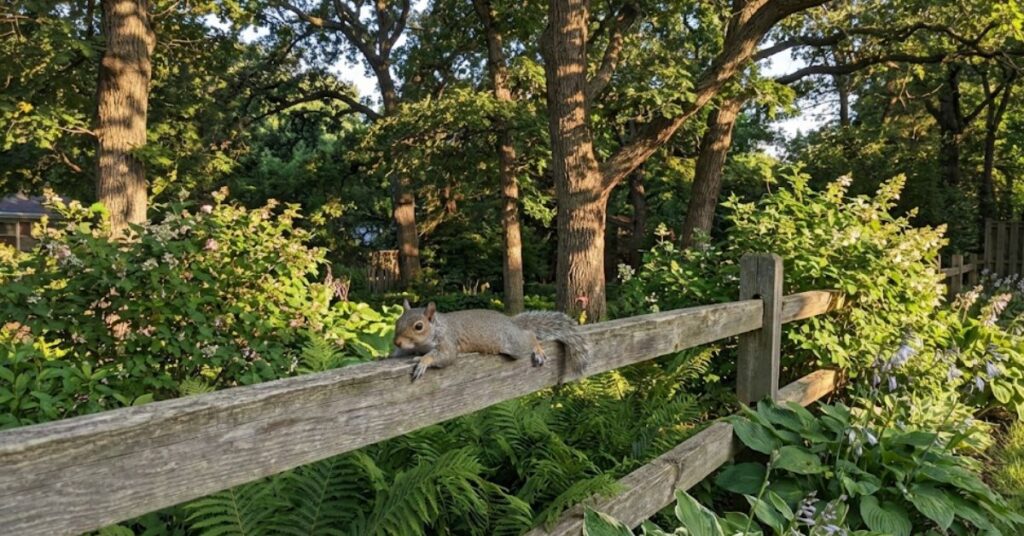
Why do squirrels lay flat on trees and the ground?
Squirrels lay flat, a behavior known as “splooting” or “heat dumping,” to regulate their body temperature. By spreading their less-furry bellies against cool surfaces like shaded wood, stone, or soil, they transfer excess body heat through conduction, allowing them to cool down without sweating.
The Science of the “Pancake Pose”
Squirrels are essentially high-octane furry motors. They spend their days sprinting up vertical bark, leaping across gaps that would make an Olympic long-jumper sweat, and arguing with blue jays. All that activity generates a massive amount of internal heat. Humans have it easy; we just sweat and complain. Squirrels don’t have that luxury.
They do have sweat glands in their paw pads, but that’s about as effective as trying to cool a warehouse with a single ice cube. Instead, they rely on a trick called conduction. Their undersides have significantly thinner fur than their backs. When a squirrel feels its internal temperature climbing—especially when we hit those record-breaking $100^\circ$F days—it looks for a “heat sink.”
By pancaking themselves against a cool surface, they are literally dumping their body heat into the environment. It is the squirrel equivalent of flipping your pillow to the cold side, except they do it with their entire bodies. They choose shaded pavement, damp garden soil, or the underside of a thick branch because those surfaces stay cooler than the surrounding air, so that they can drop their core temperature before they literally cook from the inside.
Is Splooting a Sign of Distress in 2026?
I’ll be blunt: in the old days, seeing a squirrel sploot was just a goofy summer quirk. In 2026, it’s becoming a survival necessity. Scientists at places like the University of Texas at Austin have noted that the temperatures we are seeing lately are pushing wildlife past their natural limits.
When you see a squirrel splayed out, it is under thermal stress. They aren’t “relaxing” in the way we think of a nap. They are in survival mode. If they stay in that position for hours, or if they seem oblivious to your presence, they might be crossing the line from “cooling off” to heat exhaustion.
Healthy Splooting vs. Heat Distress
| Behavior | Healthy Sploot | Heat Stroke/Distress |
| Movement | Bounces away if approached | Lethargic or non-responsive |
| Posture | Flat but alert (ears may twitch) | Appears limp or “floppy” |
| Breathing | Steady, rhythmic | Rapid, shallow, or gasping |
| Location | Shaded, cool surface | Open sun or hot concrete |
Why 2026 Is the Year of the “Permanent Sploot”
We’ve seen some weird weather this month. Parts of the South are seeing spring-like temperatures while the North is a frozen tundra. This “weather whiplash” is hard on the Sciuridae family. Squirrels grow a thick winter coat in the fall. If the temperature suddenly jumps to $75^\circ$F in January, that coat becomes a death trap.
This is why you’re seeing this behavior more frequently. The animals haven’t evolved as fast as the thermometers are rising. According to recent reports in our News section, urban heat islands—your asphalt driveways and brick patios—can stay $10^\circ$ to $20^\circ$ hotter than nearby wooded areas. If you’ve paved over your backyard, you’ve essentially turned your garden into a frying pan for the local critters.
How to Help Your Backyard Buddies (Without Being a Nuisance)
I’m not telling you to bring the squirrels into your living room and put them in front of the AC. That’s a great way to lose a finger and your security deposit. But if you want to stop seeing “crime scenes” on your porch, there are a few practical things you can do.
- Water is King: Put out a shallow dish of water. Put a few rocks in it so they have a place to stand. Hydration is the first line of defense against heat.
- Provide Real Shade: Those fancy plastic gazebos don’t breathe. Plant a real tree or some native shrubs. Natural foliage provides “evapotranspiration”—a fancy word that means plants sweat for us, keeping the air around them significantly cooler.
- Dampen the Soil: If you have a shaded corner of the garden, give it a quick spray with the hose in the late afternoon. Squirrels love to dig a small “cooling pit” in damp soil to lie in. It’s like a spa day for them, minus the cucumber slices.
I’ve spent years shouting about overpriced garden gadgets, but a simple $5 birdbath and a bucket of water are worth more than any “smart” squirrel feeder on the market. We do these small things because a healthy ecosystem starts in your own backyard, so that the wildlife can continue their job of burying acorns (and forgetting where they put them).
Quick Answers (Because I Know You’ll Ask)
What is the informal word for a squirrel lying flat?
The internet has collectively dubbed this “splooting.” It is believed to be a play on the word “splat,” describing the way the animal looks like it has been dropped from a height and flattened onto the surface.
Is splooting unique to squirrels?
Not at all. You’ll see dogs, cats, rabbits, and even bears doing it. Any mammal with a furry back and a relatively bare belly will use conduction to dump heat. Corgis are particularly famous for the “full sploot” because of their short legs and long bodies.
Should I call animal control if a squirrel is laying flat?
In 99% of cases, no. If the squirrel is in the shade and moves when you get close, it’s just cooling off. Only consider calling a wildlife rehabilitator if the squirrel is in direct sun, has its mouth open (panting like a dog), or doesn’t move when threatened.
Why do they sploot on tree branches specifically?
Tree branches, especially thick ones, have a high thermal mass. In the shade, the bark stays much cooler than the ambient air. Additionally, being high up allows for better airflow (convection) around their bodies, helping the cooling process.
Can squirrels fall out of trees while splooting?
It’s rare, but it happens. Usually, their “pancake” posture increases the surface area contact with the branch, which actually creates more friction and keeps them more secure than if they were just perched on their feet.
Does splooting happen in the winter?
Normally, no. Splooting is a heat-regulation behavior. However, with the unseasonably warm winters we’ve seen in 2026, many homeowners are reporting “winter sploots” when temperatures spike and squirrels are still wearing their heavy winter pelage.
Is it “pancaking” or “splooting”?
Both are correct. “Heat dumping” is the scientific term, “pancaking” is the old-school term, and “splooting” is the modern, internet-approved version. Use whichever makes you feel less like a crotchety neighbor.
The Grumpy Columnist’s Final Word
Look, the world is changing, and the squirrels are just trying to keep up. Seeing them flat as a tortilla on your deck is a little weird, sure, but it’s just nature’s way of handling a hot day. Don’t go poked them with a stick. Don’t go calling the feds. Just make sure they have a bit of water and some shade.
We’re all just trying to survive the heat index. If you’re planning on doing some landscaping to cool down your yard this spring, check out our homepage at hometoolcreatives.com for some real talk on which plants actually provide shade and which ones are just overpriced weeds.
Related Post:
