

I stood in the garden center yesterday watching a guy load forty bags of “premium” dirt into a sedan that looked like it was about to snap an axle. I almost walked over to tell him he only needed half that—but then I realized he probably just “eyeballed” his new 4×8 bed. If you enjoy throwing money into a plastic bag and hauling it across your yard for no reason, be my guest. But for the rest of us who value our backs and our bank accounts, we need to talk about using a soil calculator for raised beds.
It is January 19, 2026, and the industry is currently obsessed with “regenerative gardening” and soil health. That’s great, but you can’t regenerate soil you haven’t even bought yet—and you certainly shouldn’t be buying twice what you need. Whether you are building a maximalist floral retreat or a sensible veggie patch, the math doesn’t change.
Let’s get the numbers right so you can spend your time planting, not returning heavy bags of mud.
The Direct Answer: How Much Soil Should You Buy?
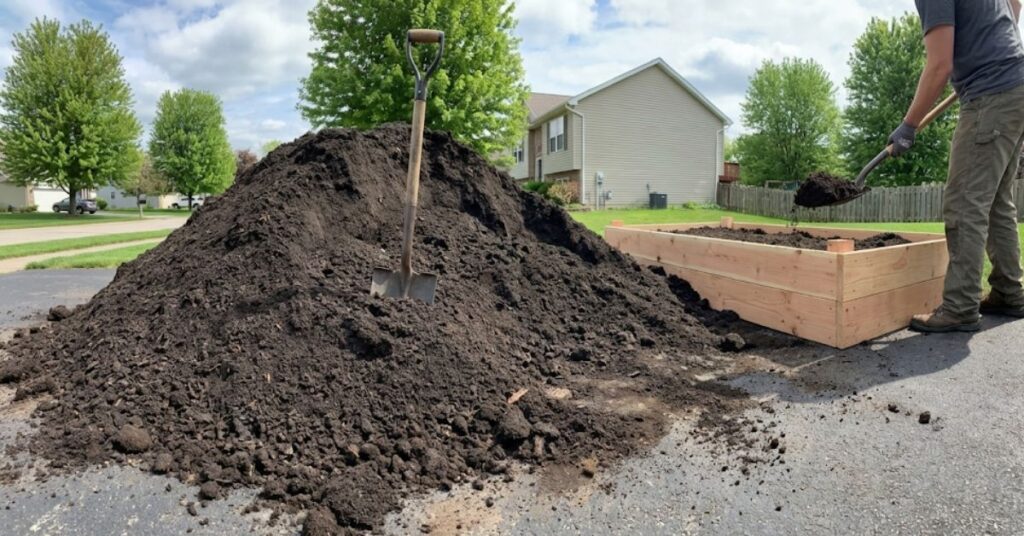
To determine how much soil to buy, use the formula Length (ft) x Width (ft) x Depth (ft) to find the total cubic feet. For bulk orders, divide that total by 27 to get cubic yards. Most standard 4’x8′ beds with 12″ depth require exactly 32 cubic feet of soil.
The “Dirty” Math: Why Your Eyes Lie to You
Most people fail at the garden center because they think in “piles” instead of “volume.” A bag of soil looks huge on the pallet, but it vanishes the second you spread it out.
To calculate your needs accurately, you must measure the inside dimensions of your bed. Boards have thickness, and if you measure the outside, you’re buying dirt for the wood, which last I checked, doesn’t grow much.
- Length x Width: This gives you the square footage.
- Depth: This is the kicker. Convert your inches to feet by dividing by 12. A 6-inch bed is 0.5 feet; an 18-inch bed is 1.5 feet.
- The Volume: Multiply your square footage by that depth.
Bulk vs. Bags: Which One is Ripping You Off?

If you only have one small 4’x4′ bed, buy the bags. If you have three 4’x8′ beds, and you buy bags, you’re either a glutton for punishment or you don’t realize that bulk delivery is often 30% cheaper.
Bulk soil is sold by the “yard” (cubic yard). One yard is 27 cubic feet. For a project that requires over 25 cubic feet, call a local landscape supply and get a “tote” or a truckload.
Quick Bag Count Reference (For 2 Cubic Foot Bags)
| Bed Size | Depth | Total Volume | Bags Needed |
| 4′ x 4′ | 6 inches | 8 cubic feet | 4 Bags |
| 4′ x 4′ | 12 inches | 16 cubic feet | 8 Bags |
| 4′ x 8′ | 12 inches | 32 cubic feet | 16 Bags |
| 4′ x 8′ | 18 inches | 48 cubic feet | 24 Bags |
The “Perfect” Raised Bed Soil Mixture
Don’t just buy “topsoil.” Topsoil is often just screened fill dirt that turns into a brick the second it gets wet. For a raised bed, you need a mix that drains because it isn’t connected to the deep earth’s drainage system.
University extensions recommend a “controlled soil mixture” to ensure root growth. A reliable ratio is the 60/30/10 rule:
- 60% Quality Topsoil: For structure and mineral base.
- 30% Compost: For nutrients and organic matter.
- 10% Potting Mix or Perlite: To keep things light and improve drainage.
Alternatively, many gardeners swear by equal parts (1/3 each) of topsoil, compost, and a drainage material like vermiculite or perlite.
Quick Answers (Because I Know You’ll Ask)
How many bags of soil do I need for a 4×8 raised bed?
For a standard 12-inch deep bed, you need 32 cubic feet of soil. If you are buying 2-cubic-foot bags, that is exactly 16 bags. If the bags are smaller (1.5 cu ft), you’ll need 22 bags.
Is it cheaper to buy soil in bulk or bags?
Bulk is almost always cheaper for larger projects. However, remember to account for delivery fees. If you need less than 20 cubic feet, the convenience of bags usually wins out.
What is the best soil mix for raised beds?
The gold standard is a blend of 60% topsoil and 30% compost, with 10% soilless add-ins like perlite for aeration. Avoid using 100% native garden soil, as it will compact in the bed and suffocate your roots.
How deep should soil be in a raised bed for vegetables?
Most vegetables need 12 to 18 inches of depth to accommodate their root systems. Shallow-rooted crops like lettuce can survive in 6 inches, but heavy hitters like tomatoes or carrots need the deeper stuff.
How much soil for a 4×4 raised bed?
A 4×4 bed at a 1-foot depth requires 16 cubic feet of soil. If you only need it 6 inches deep, it’s 8 cubic feet.
Do I need to remove grass under a raised bed?
You don’t have to, but you should scalp it short and line the bottom with cardboard or newspaper to suppress weeds while it dies off. If your soil is heavy clay, tilling the ground before building the bed can help with long-term drainage.
How do I calculate soil for a circular raised bed?
Use the formula $\pi \times r^2 \times \text{Depth}$. Measure the diameter across the top, divide it by two to get the radius ($r$), square it, multiply by 3.14 ($\pi$), and then multiply by your depth in feet.
Wrap It Up: Don’t Forget Settling
Soil is like a new pair of jeans; it’s going to shrink after the first wash. Water and gravity cause soil to settle and compact over time. Plan to buy an extra 10-15% more than your calculated volume so your bed doesn’t look half-empty by July.
Check the News category for updates on regional soil availability—2026 is looking like a busy year for home gardening, and supplies can get tight in the spring.
Related Post:
