
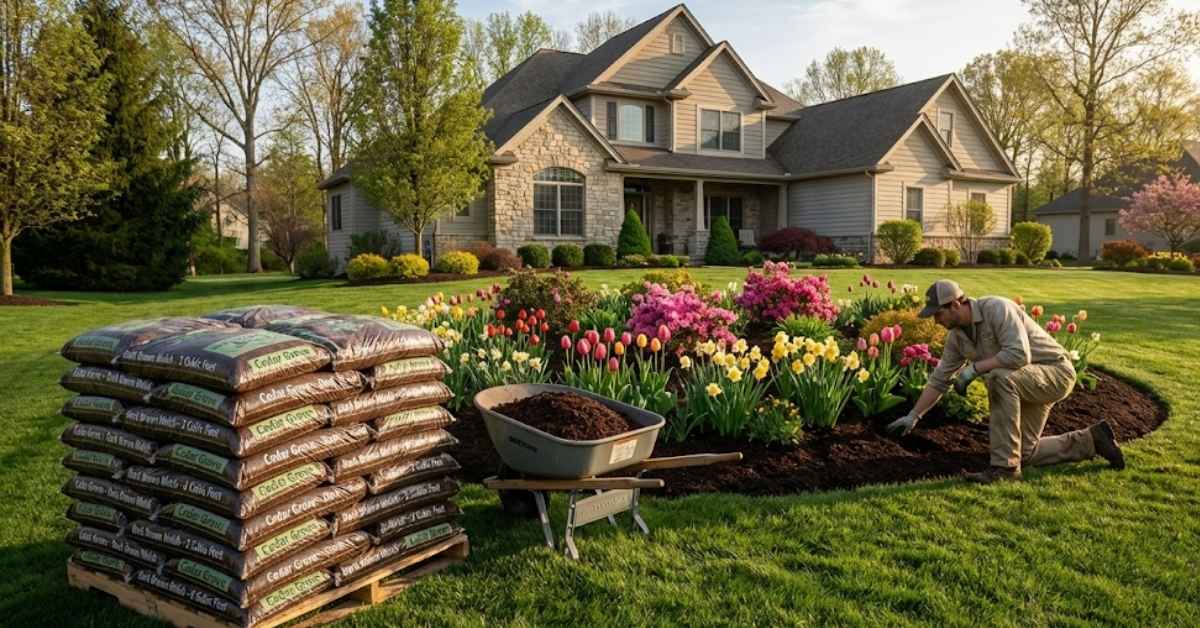
Look, I’ve been there. You’re standing in the middle of the garden center, staring at a mountain of 2 cu ft mulch bags, scratching your head. You know your flower bed needs a “yard” of mulch, but the bags are sold in cubic feet. Do you buy ten? Twenty? Do you just keep loading the cart until the teenager working the lot looks worried about your truck’s suspension?
It’s a classic DIY headache. If you buy too few, you’re making a second trip back to the store, smelling like cedar and sweat. If you buy too many, you’ve got 20 bags of mulch rotting behind the shed for three years. Let’s stop the guessing game right now.
The Direct Answer: How Many Bags of Mulch Equal a Yard?
To get straight to the point: A standard cubic yard of mulch is equal to 13.5 bags of mulch if you are using 2 cubic foot bags. Since you can’t usually buy half a bag, you will need 14 bags of mulch to cover one cubic yard. If you are using larger 3 cu ft bags of mulch, you only need 9 bags to reach one cubic yard.
The Simple Math: Breaking Down the Cubic Yard

Before we get into the weeds, let’s talk numbers. A “yard” in the landscaping world is actually a cubic yard. Picture a box that is 3 feet wide, 3 feet long, and 3 feet tall. That is a lot of space to fill.
Most big-box stores like Home Depot or Lowe’s sell 2 cubic foot bags. Since there are 27 cubic feet in one cubic yard ($3 \times 3 \times 3 = 27$), the math is simple. You divide 27 by the bag size.
- 2 cubic foot bags: 13.5 bags per yard.
- 3 cubic foot bags: 9 bags per yard.
- 1 cubic foot bags: 27 bags per yard.
- .75 cu ft bags in a yard: 36 bags per yard.
If you’re doing a big project, you might be asking how many bags of mulch are in a pallet. Usually, a pallet of mulch holds between 60 to 70 bags of the 2 cu ft size. That means one pallet is roughly 4 to 5 cubic yards.
Quick Reference: Mulch Bag Conversion Table
| Project Size (Cubic Yards) | Bags (2 cu ft size) | Bags (3 cu ft size) |
| 1 Yard | 14 Bags | 9 Bags |
| 2 Yards | 27 Bags | 18 Bags |
| 3 Yards | 41 Bags | 27 Bags |
| 5 Yards | 68 Bags | 45 Bags |
| 10 Yards | 135 Bags | 90 Bags |
Pro Tip: I always tell people to buy one extra bag. Nothing is worse than being three feet away from finishing a hedge line and realizing you’re out of wood chips. Plus, 1 yard mulch how many bags depends on how much you settle the mulch.
Bulk vs. Bagged Mulch: Which One Should You Pick?
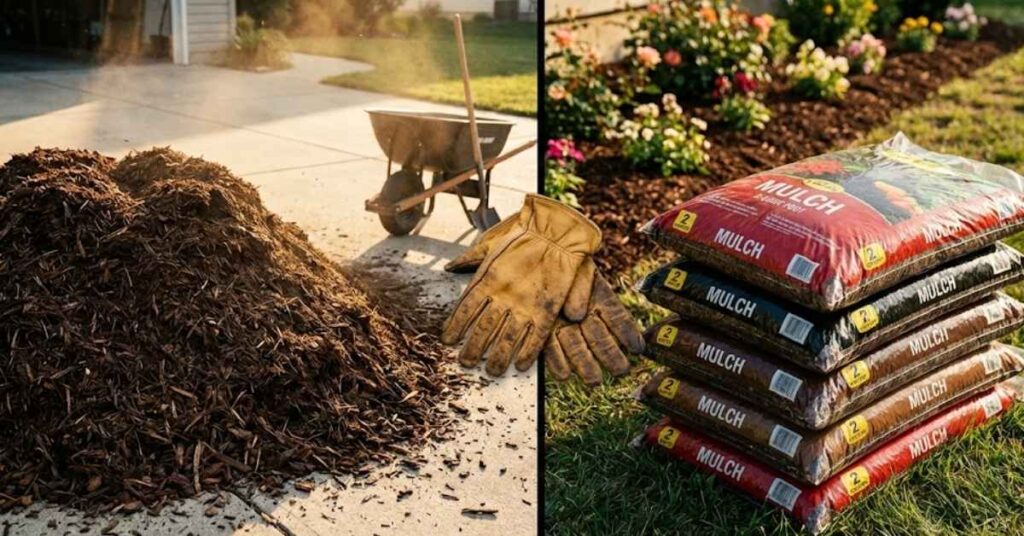
This is where I get a little blunt. I hate hauling bags. My back hates it, and my trash can hates the 50 empty plastic wrappers afterward. But, bags vs bulk mulch is a debate that depends on your truck and your patience.
Bulk mulch is usually cheaper. You pull up with a pickup truck, they drop 1 scoop of mulch (which is usually a half-yard or a full yard depending on the loader) into the bed, and you drive away. But how many bags of mulch fit in a pickup? A standard short-bed truck can hold about 1.5 to 2 cubic yards of loose mulch. If you tried to do that with bags, you’d be looking at 27 to 40 bags of mulch.
Bagged mulch is better if:
- You don’t have a truck.
- You need to carry the mulch through a narrow gate to the backyard.
- You want a specific color or texture that the bulk pile doesn’t have.
- You’re worried about termites in mulch bags (though this is rare with high-quality treated mulch).
If you’re wondering how much do bags of mulch weigh, they are usually 20 to 40 pounds depending on moisture. If it rained recently at the store, those bags will be heavy as lead.
Calculating Your Needs Like a Pro

Don’t just guess. Use a tool. I highly recommend using the Mulch Calculator to get your exact numbers.
To do it by hand, you need the square footage of your garden.
- Measure the length and width (e.g., 10ft x 10ft = 100 sq ft).
- Decide on depth (3 inches is the gold standard for weed control).
- Multiply: $100 \times 0.25$ (since 3 inches is 1/4 of a foot) $= 25$ cubic feet.
- Since 27 cubic feet is a yard, you need just under 1 yard of mulch.
If you’re also doing soil work, the math stays the same. How many bags of soil in a cubic yard? It’s the same 27 cubic feet. However, soil bags are often smaller, so how many bags of soil for 1 cubic yard often ends up being closer to 40 or 50 bags if you buy the tiny 0.75 cu ft ones.
Dealing with Pallets and Large Quantities

If you have a massive yard, you might be looking at 5 cubic yards of mulch is how many bags. That’s roughly 68 bags. At that point, just buy the pallet.
How many bags in a pallet of mulch? Most stores will sell you a full wrap. Not only is it easier to transport if they have a forklift, but you often get a bulk discount. How many bags of mulch are in a yard remains the same, but the price per bag drops.
When you see 40 bags of mulch is how many yards, just divide by 13.5. You’re looking at about 3 yards of material. That’s enough to cover about 324 square feet at 3 inches deep.
Common Pallet Counts
- 60 bags: ~4.4 yards
- 70 bags: ~5.2 yards
- how many bags mulch in a pallet usually caps at 75 for safety.
Why Is My Math Wrong? (The Moisture Factor)

I’ve had neighbors complain that they bought 13.5 bags of mulch and it didn’t fill their 1-yard garden box. Here’s the “grumpy expert” truth: mulch settles.
When you pour mulch out of the bag, it’s fluffy. After one rainstorm, it packs down. If you want a true 3-inch depth after it settles, you might actually need 15 bags of mulch for a cubic yard. This is why the question how many bags of mulch is 1 yard is technically 13.5, but practically 15.
Also, watch out for the bag size! A size of mulch bag can vary. While 2 cubic foot bags are common, some “economy” brands use 1.5 cu ft. If you use those, how many bags of mulch for a yard jumps to 18!
FAQ: Your Mulch Questions Answered

Q: How many bags of mulch in a yard?
A: There are 13.5 bags (2 cu ft each) in one cubic yard.
Q: How many bags of mulch for a yard of coverage at 2 inches deep?
A: One yard covers 162 square feet at 2 inches. You’ll need 14 bags.
Q: How many bags of mulch is 2 yards?
A: That would be 27 bags (2 cu ft each).
Q: How many bags of mulch make a yard if they are 3 cu ft?
A: You only need 9 bags.
Q: How many bags of dirt in a yard?
A: Just like mulch, it’s 27 cubic feet. If the dirt bags are 1 cu ft, you need 27 bags.
Q: How many yards is 30 bags of mulch?
A: 30 bags (2 cu ft) is approximately 2.22 cubic yards.
Q: How many bags are on a pallet of mulch?
A: Usually 60 to 70 bags per pallet.
Q: How many bags of mulch is in 1 yard of bulk delivery?
A: A bulk yard is equivalent to 13.5 standard bags.
Q: Does 1 scoop of mulch equal a yard?
A: Usually, a tractor scoop is 1/2 yard or 1 yard. Ask the yard operator first!
Q: How many bags of soil is 1 cubic yard?
A: If using 1 cu ft bags, it’s 27. If using 40lb bags (which are often .75 cu ft), it’s 36 bags.
Final Thoughts
Calculating how many bags of mulch in a cubic yard doesn’t have to be a nightmare. Just remember the magic number: 13.5. Round up to 14, and you’re golden. Whether you’re figuring out how many bags of mulch for 1 yard or tackling a massive project that requires 10 yards of mulch, always measure twice and buy once.
If you’re still feeling unsure about your garden dimensions, go check out our Raised Bed Soil Calculator to make sure your plants have enough room to breathe.
Related Post:
